
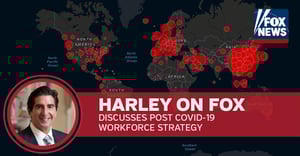
Spending nearly two months working from home during the COVID-19 pandemic, companies are giving a lot of thought to their workforce strategy going forward. To get a read on where the nation is heading, Neil Cavuto of Fox Business asked Harley Lippman, CEO of Genesis10 about the future of work post-coronavirus.

“Companies are looking to do more with less. They are refocusing their workforce strategy,” Lippman said. “They are looking to minimize their risk by diversifying their operations, especially in IT.”
Now, many companies have their IT operation all in one place, Lippman explained, and they don’t know when the next disaster—another pandemic, a terrorist attack—is going to strike. “Having work done in various, smaller locations, outside the hub of the operation” will mitigate their risk,” he said.
Learn how Genesis10 is helping clients de-risk their workforce strategy by building IT Delivery Teams across the United States.
Harley’s leadership extends beyond business. He serves on the boards of leading business, academic, and policy institutions. His appointments include the U.S. Agency for International Development’s Partnership for Peace Advisory Board, where he helps advance efforts to foster trust and cooperation between Israelis and Palestinians. He has also served, by presidential appointment and Senate confirmation, on the U.S. Commission for the Preservation of America’s Heritage Abroad under multiple administrations.
He sits on the boards or advisory councils of Yale University’s School of Management, Columbia University’s School of International and Public Affairs, the Brookings Institution, The Washington Institute, the Middle East Forum, and the American Israel Public Affairs Committee (AIPAC), where he serves on the Political Leadership Council and Executive Committee.
Previously, Harley served as public director of the New York Mercantile Exchange and held leadership positions with the American Jewish Congress and the America-Israel Friendship League.
A committed philanthropist, Harley is the sole financial supporter of an orphanage in Cambodia, where he has helped dozens of children access education and opportunity, including funding college tuition for many. He has also led efforts to identify and memorialize unmarked Holocaust mass graves in Eastern Europe, helping preserve the memory of those lost. His documentary, Safeguarding Memory, aired on PBS and received two awards for its impact and storytelling.
Harley continues to combine business leadership with civic responsibility, making lasting contributions to the fields of technology, education, diplomacy, and remembrance.
