
As the pace of change in technology continues to accelerate, Strategic Sourcing and Vendor Management are in an optimal position at their companies. These groups can see what's happening and what's working—and why, such as where emerging technology is a good fit. This helps the enterprise to avoid missteps, be faster and more nimble as it navigates through complex changes and broader digital transformation.
Summary
Digital disruption is accelerating the push to modernize IT and scale digital transformation, with Strategic Sourcing and Vendor Management well-positioned to guide the enterprise. After years of experimentation, new funding and confidence are moving pilots in automation, Cloud and DevOps to full implementation, with modernization capturing most spend and demanding significant core execution investment. A tightening labor market—especially in DevOps, Artificial Intelligence, Data/BI, Cloud, CyberSecurity and Blockchain—has become the primary constraint, forcing new it staffing strategies. Executives are leaning on consulting firms for strategy while seeking cost-effective execution and sustainment models, making access to the right talent the key to speed, agility and outcomes.
Digital Disruption
Digital adoption is disrupting many industry segments, creating complexities, shaking things up and forcing enterprises to take a hard look at the timelines to execute against business and technology strategies.
Enterprises that haven't made the transition to digital are going to have to make their changes "while the plane is flying in the air." They are coming to grips with what their businesses look like, what digital disruption means in the marketplace and how they are going to react, says Michael Janssen, Chief Research Guru at Everest Group.
Marketplace Changes Ahead
Increased focus on IT Modernization and enterprises piloting new digital frameworks—automation, Cloud, DevOps applications—is now moving to full-on implementation. Analysts at Everest Group believe that IT modernization will capture the majority of dollars going forward this year. And, according to Gartner, through 2019, every $1 that enterprises invest in innovation will require an additional $7 in core execution. Consistently at Genesis10, we see our clients accelerate their digital business transformation initiatives which in turn drives them to modernize infrastructure and applications, guided by a pragmatic it modernization strategy.
Everest Group CEO Peter Bendor-Samuel explains that having done sufficient experimentation, building confidence in new models, the industry, with new funding, is prepared to act. As part of the recent federal tax cut and repatriation of funds back to the U.S., political pressure is on companies to use part of those funds for investment, and "IT is raising its hand very high," he says. "IT is prepared to modernize, to become more efficient, more agile and better aligned with the business—and it is going to need substantial capital to do it," especially as digital transformation scales.
Drilling Down
As a whole, the industry is aware of this pivot to digital. For the past three years, it's been a story of demonstrating mastery of technology and/or acquiring technology. Investments now are focused on positioning to drive these initiatives. The next challenge to tackle is the workforce. Do businesses have the skills and capabilities required to deliver? Despite a robust economy and strong demand for talent, 2018 IT job growth is essentially flat according to Staffing Industry Analysts. Many will attribute this to the shortage of IT talent for high-demand skillsets particularly in the emerging technology arena. Tight talent market is further exacerbated by immigration reform and changing risk appetite. This reality has sharpened attention on it staffing strategies that balance speed, quality and cost while coping with an it skills shortage.
According to Remster Bingham, Vice President of Recruiting at Genesis10, the six most challenging technology areas to recruit for are: DevOps, Artificial Intelligence, Data/BI, Cloud, CyberSecurity and Blockchain. The tight labor market, supply and demand and immigration reform are compounding factors. Recently, Genesis10 surveyed IT Executives from Fortune 1000 companies to understand how they are responding to the tight labor market to infuse capabilities and shore up resourcing gaps. Collectively, these domains represent some of the most in-demand it skills. This is what we learned:
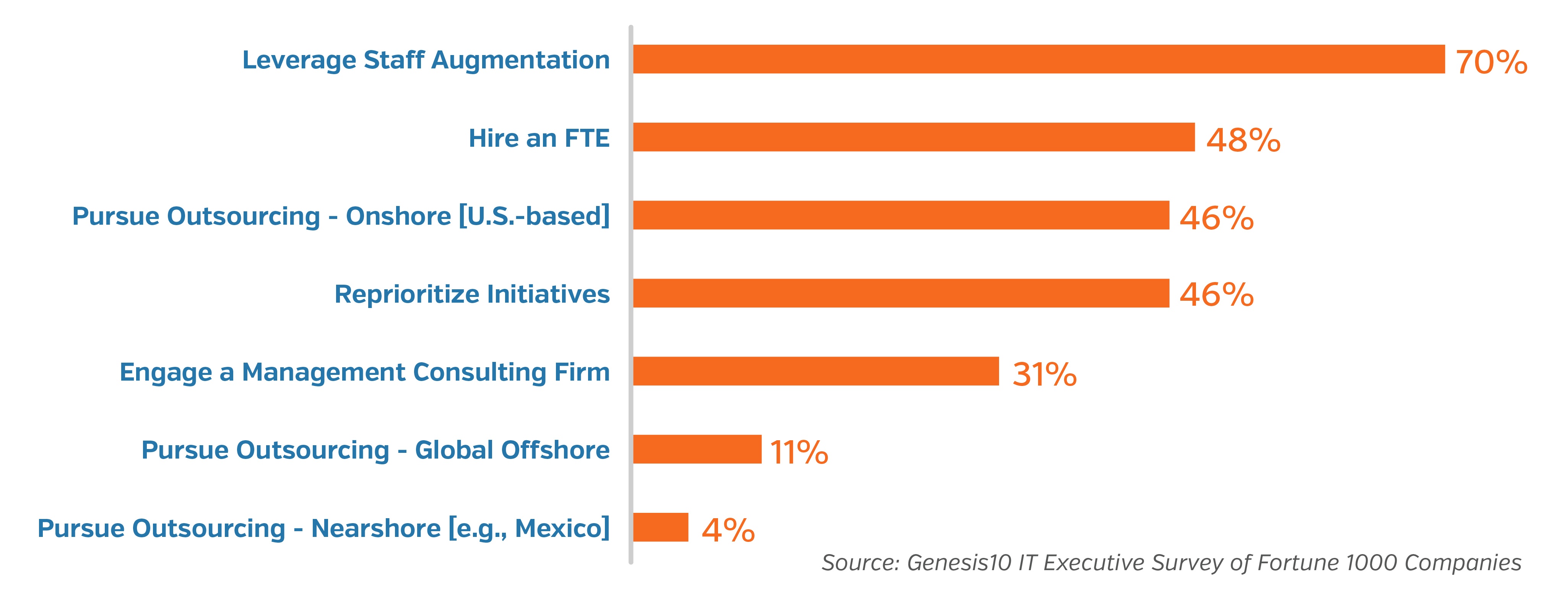
From the survey, we understand that due to continued pressure to reduce cost, IT Executives are shifting to use management consulting firms for strategy work and less for execution and sustainment work efforts.
The pressure is certainly on to take cost out, do more with less and most definitely capitalize on technology. Having access to talent will play a critical role in the game of speed.
Q&A
Question: Why are Strategic Sourcing and Vendor Management well-positioned to guide IT modernization?
Answer: They have broad visibility into what technologies are working across the enterprise and where emerging solutions fit best. This vantage point helps the business avoid missteps, move faster, and stay nimble as it navigates complex change and broader digital transformation.
Question: What is driving the shift from pilots to full implementation in areas like automation, Cloud, and DevOps?
Answer: After years of experimentation, organizations have gained confidence in new models and are receiving fresh funding—bolstered by tax cuts and repatriated cash—with pressure to invest. As a result, modernization is capturing most spend, and, per Gartner, each $1 invested in innovation through 2019 requires an additional $7 in core execution, pushing substantial investment into scaling and operating these solutions.
Question: What is the primary constraint to scaling digital transformation?
Answer: Talent supply. A tight labor market—compounded by supply-demand imbalances, immigration reform, and changing risk appetite—has made key skills scarce. The most challenging areas to recruit for are DevOps, Artificial Intelligence, Data/BI, Cloud, CyberSecurity, and Blockchain, with 2018 IT job growth essentially flat per Staffing Industry Analysts.
Question: How are executives adjusting sourcing strategies to cope with tight talent and cost pressures?
Answer: They are leaning on management consulting firms for strategy while shifting execution and sustainment to more cost-effective models. At the same time, they are sharpening IT staffing strategies that balance speed, quality, and cost, recognizing that access to the right talent is critical to agility and outcomes.
Question: What does “making changes while the plane is flying” mean for enterprises behind in digital?
Answer: It means they must transform business models and technology stacks without halting day-to-day operations. As they reassess what their businesses should look like in a disrupted market, they must simultaneously react and execute—modernizing infrastructure and applications under a pragmatic strategy while keeping the organization running.