
Hiring has always been a trade-off between speed and personal touch. Old methods rely on human judgment, which can be slow and uneven.
AI in recruitment is changing that. It handles repeat tasks, scans large sets of candidate data, and finds top talent fast. As AI reshapes the hiring process, one question remains: can tech beat recruiters, or is the human touch still essential?
Summary
AI is changing recruitment. It automates tedious work, reviews candidate data fast, and may help reduce bias in recruitment. That gives human recruiters more time for relationship-building and culture fit.
The benefits of AI in hiring include speed, lower cost, and more even screening. But people still bring judgment and context. Together, they can support a better candidate experience.
Why Employers Are Turning to AI
To keep up with hiring volume, many employers use AI candidate screening. These AI recruitment tools can save time and cut costs.
They can also support reducing bias in recruitment by standardizing some steps. That helps teams compare candidates in a more even way.
Will AI Replace Human Recruiters?
People often ask if robots will take over hiring. The short answer is no. AI recruitment tools are built to support recruiters, not replace them.
The AI vs human recruiters debate is really about support, not replacement. AI speeds up the work, but it does not replace human judgment. The future of hiring is more likely to be a team effort.
How AI and Human Recruiters Work Together
- AI makes hiring faster by handling low-value tasks. Then it sends the candidate to a recruiter for deeper review.
- Human recruiters know the company's culture and benefits. That helps them sell the role well.
- Together, AI and people make recruitment automation more useful and more personal.
Feedback and Continuous Improvement
- AI can send emails or texts to ask for feedback on the candidate experience.
- But it cannot improve the process on its own.
- A person must read the feedback and make changes.
That is where candidate experience automation helps most. AI gathers the data. People turn it into action.
Expert Perspective
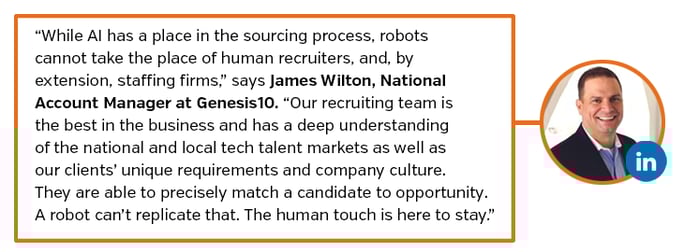
While AI has a place in the sourcing process, robots cannot take the place of human recruiters, and, by extension, staffing firms, says James Wilton, National Account Manager at Genesis10.
Our recruiting team is the best in the business. They know the national and local tech talent markets, and they understand our clients' unique needs and company culture. They match candidates to jobs with care. A robot can't copy that. The human touch is here to stay.
Q&A
Question: Will AI replace human recruiters?
Answer: No. AI tools are built to support human recruiters, not replace them. AI speeds up routine work and early screening. Humans still handle judgment, culture fit, and relationship-building.
Question: What parts of the hiring process does AI handle best?
Answer: AI is best at fast, large-scale tasks. It automates repeat work, screens large sets of candidate data, and sends routine messages like feedback requests. This helps recruiters focus on higher-value work.
Question: Where do human recruiters add the most value?
Answer: Humans add the most value when context matters. They judge culture fit, explain the role, and act on client and candidate feedback. Their market knowledge helps create a more personal experience that AI cannot fully match.
Question: Can AI reduce bias in hiring?
Answer: Yes, it can help. AI may reduce bias in recruitment by standardizing some steps and decisions. But people still need to review results and make sure the process is fair.
Question: What happens after AI collects candidate experience feedback?
Answer: AI can gather feedback through emails or texts, but it does not improve the process on its own. A recruiter or hiring team must review the feedback and make changes. That shows how AI and people work best together.