
When you think about looking for a new job, three main job-search tactics come to mind: leveraging your network, drafting and sending out resumes, and polishing your interview skills. For veterans in tech and other fields, that first step can include veteran networking groups, mentors, and peers who can translate industry norms.
Conversely, those three job-search areas are where military members' skills either atrophy during their course of service or don't exist in the first place, and may be one reason why veterans' unemployment continues to be nearly double the rate of the average civilian. This gap is especially visible when veterans in tech transition from service into civilian roles.
Summary
Veterans often face civilian job-search hurdles—networking, resume writing, and interviewing—because military culture and systems discourage networking outside the chain of command, don’t use resumes, and minimize self-focused language. These gaps are especially challenging in tech, where translating military technical experience into business outcomes and communicating impact are critical. Focused support through mentorship, veteran networking, resume translation, and interview coaching, along with educating hiring managers, helps close the gap. With the right guidance, veterans can confidently navigate and succeed in business and IT careers.
1. Networking
In the military, going outside the chain of command is essentially networking—what many would label networking in military culture. The military teaches very early on that talking to people outside the chain of command is tantamount to mutiny. One veteran recalls returning from Iraq amped up to return but his contract was set to expire. A unit training at his base was short of officers, so he took the initiative to offer his services. This was a mistake. The service member was reprimanded for actively seeking a position with another unit. Notwithstanding that he was volunteering to waive his rest time in the U.S., deploy to a war zone with a unit short of experienced officers, and giving the Corps one more deployment, this breach of protocol was considered taboo.
As a result, veteran networking after service can feel counterintuitive, even though it is essential in the civilian market and especially useful for veterans in tech.
2. Resume Writing
There is no such thing as a resume in the military. Instead a soldier's service record book, or consolidated list of duty stations, schools attended and positions held, is reviewed at the highest headquarters "manpower" division.
They simply match current openings with current rank profiles to give each veteran their next "job." This isn't a system that requires each individual to write their own version of events thus, resumes do not exist in the military. Translating technical experience into concise, business-friendly achievements is crucial for veterans in tech pursuing roles in software, data, or cybersecurity.
3. Interviewing
Talking about oneself during an interview is seen as self-aggrandizing. One veteran recalls Marine Corps boot camp in 1999, where he was forbidden to use the word "I," and discipline was immediately administered in the form of harsh verbal reprimands, physical fitness or the repeating of mundane tasks.
After months and years of unlearning the word "I," it can becomes very hard for service members to speak about themselves. This becomes magnified during an interview where most people are nervous, and thus revert back to their foundational training. For service members this means:
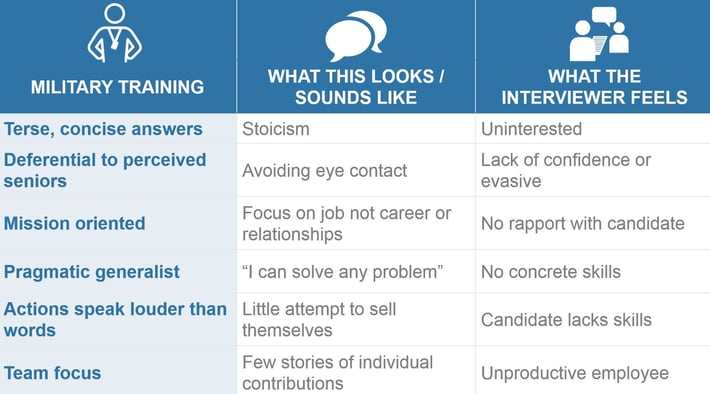
Service members are told for a minimum of four years -- and generally, these are very formative years as they occur at the outset of that individual's professional career -- that they do not have to think about managing their careers in the way a typical employee in corporate America would because the military decides where they will go and what they will do. Therefore, most veterans do not gain the skills critical to selling themselves as desirable candidates in the competitive white collar workforce. Targeted coaching helps veterans in tech practice speaking about impact, tools, and outcomes without feeling boastful.
How do we change this?
At Genesis10, we know that many veterans coming out of active duty haven't cultivated the skills necessary to present themselves in a way that accurately represents their experience and aptitude, but we understand that this is a challenge that can be met. Through translating military experience into terms employers understand, providing in-depth interview coaching and educating hiring managers on the how to accurately evaluate a veteran candidate, veterans are able to overcome the main obstacles they face when attempting to gain access to a business or IT career. We also encourage veteran networking through mentors, professional associations, and events that help veterans in tech build relationships and confidence.
Our team of recruiters is passionate about helping people find meaningful work and helping companies hire great talent. With more than 150 experienced recruiters, we focus on building connections that lead to lasting success in contract, contract-to-hire and permanent roles across technology and business functions. The team stays current on hiring trends and market insights and often shares their expertise to help professionals and employers navigate the changing world of work.
Q&A
Question: Why is networking often difficult for veterans, and why does it matter in tech?
Answer: Military culture emphasizes the chain of command and discourages going “outside” it, so what civilians call networking can feel like breaking protocol. After service, that mindset makes outreach feel counterintuitive—even when it’s expected in the civilian market. In tech especially, relationships help candidates learn industry norms, get referrals, and translate experience. Veteran networking groups, mentors, peers, professional associations, and events provide a comfortable on-ramp to build connections and confidence.
Question: Why don’t many veterans have resumes, and how should they approach writing one for tech roles?
Answer: The military doesn’t use resumes; assignments are handled centrally via a service record and manpower matching. Because service members aren’t asked to craft personal narratives, resume skills often never develop. For civilian tech roles in software, data, or cybersecurity, veterans should translate military technical work into concise, business-friendly achievements that highlight impact, tools used, and outcomes—so employers can quickly see relevance and value.
Question: What makes interviewing challenging for veterans, and how can they talk about themselves without feeling boastful?
Answer: Many service members are trained to avoid “I” language and self-focus, which can resurface under interview stress. That makes it hard to articulate personal contributions. Targeted coaching helps veterans practice discussing their individual impact, the technologies and methods they used, and measurable results—framing it as clear communication of value rather than self-aggrandizement.
Question: What should hiring managers do to better evaluate veteran candidates for tech roles?
Answer: Educate interviewers on how military experience maps to business needs, and look beyond polished networking or self-promotion. Ask about outcomes, tools, and problem-solving, and be open to translating titles and responsibilities into civilian equivalents. With modest guidance, veterans’ aptitude and mission-driven experience become much more visible.
Question: How does Genesis10 support veterans transitioning into business and IT careers?
Answer: Genesis10 focuses on closing the networking, resume, and interviewing gaps. The team helps translate military experience into terms employers understand, provides in-depth interview coaching, encourages veteran networking through mentors, associations, and events, and educates hiring managers on fairly evaluating veteran candidates. With more than 150 experienced recruiters working across technology and business functions, they build connections that lead to contract, contract-to-hire, and permanent opportunities.